The days are getting noticeably longer and it is a wonderful, joyful thing. Today it was still light after 5pm, by the end of the month it will be light until after 6 (if you include twilight). There have been a few sunny and mild days over the last couple of weeks; yesterday it was warm enough to sit outside in the garden and enjoy a cup of tea with the weakly warm sun on my face. Lovely.
This time of year is all about hope and optimism. I’m probably sowing way more seeds than I have space to grow on, much too early in the season. I don’t care, it doesn’t matter – the point is that each sown seed at this time of year is a little act of faith that the short dark days of winter will soon be behind us, and hope that the lovely spring light, warmth and lovely unfurling of life aren’t too far away.
Seedlings germinating
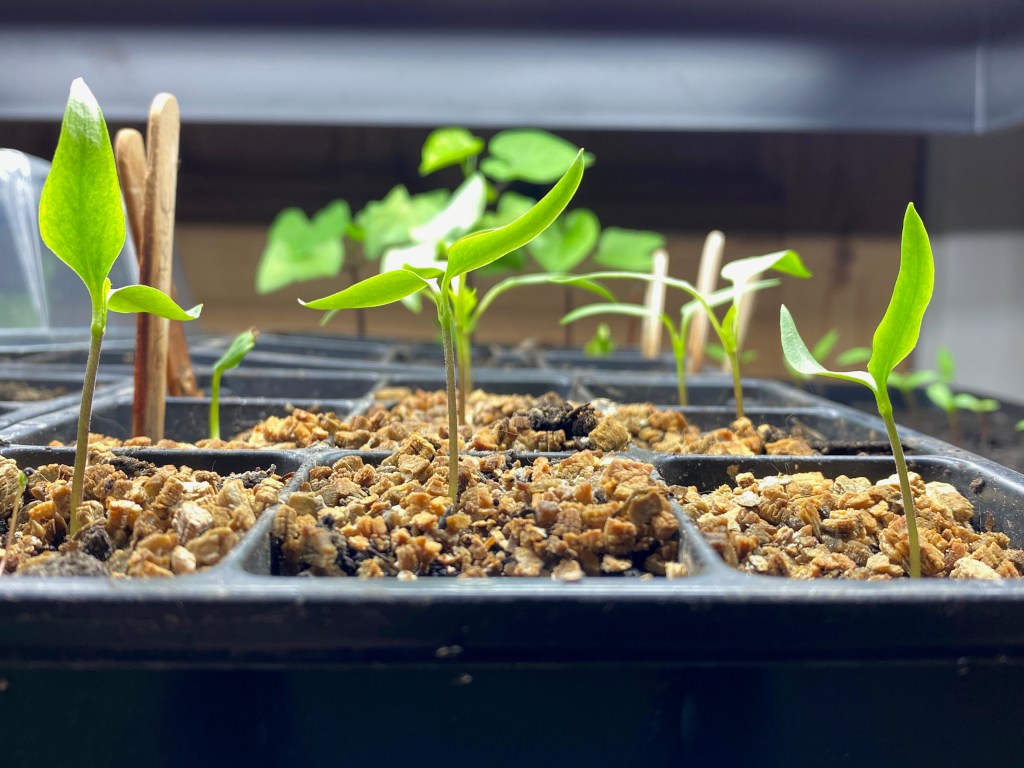
The seedlings I sowed over the last couple of weeks in the heated propagator have started to germinate already and seem to be growing well under their new lighting rig – they’re all looking lovely, green and stubby as they should. I’m delighted with it all.
I wish I had bought a rig like this years ago, it’s a brilliant way to get things going a bit early and should make all the difference to my peppers and aubergines (and the tomatoes once I sow those too). I’ve ordered a second one to grow on small plants until it’s warm enough for them to go outside, so I can continue sowing seeds in the first one.
The seedlings around the edges are leaning in just slightly towards the centre where the light is strongest – I’ve been wondering about putting some foil around the sides to reflect light back in, but I don’t want to overheat it or restrict the air flow around the plants so I’m leaving it as is for now…
The new growhouse is up and running
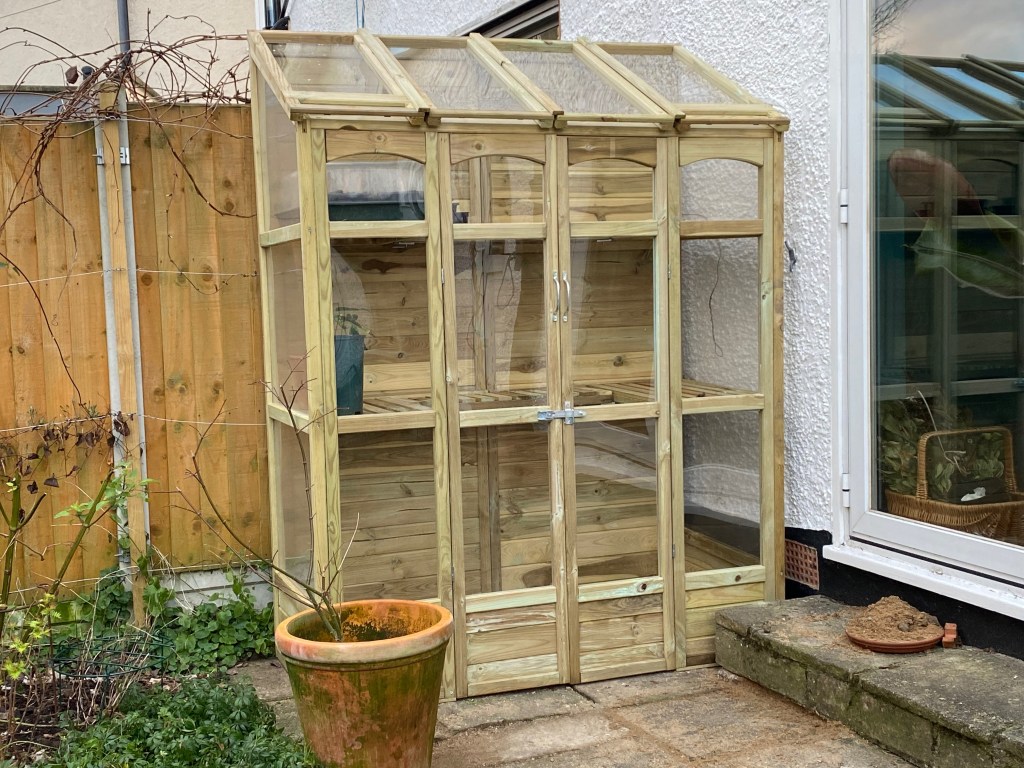
Today we finished putting together the new tall wall growhouse. It took about 5 hours for two of us to put it together, across a couple of weekends (including the bits where we had to go back a couple of steps having realised we’d done it wrong!). It was a fiddly job, but we got there in the end. A pilot drill and electric screwdriver were absolutely essential.
It’s perfect for the little 4ft x 2ft space I cleared for it in a previously not very well used corner by the garden fence, and now it’s constructed it feels solid and sturdy and looks lovely I think. I decided not to paint it as I like natural wood and it comes pre-treated so there’s no particular need. I’m really pleased with it and excited to have all this extra space for seedlings and tender plants. I
can’t wait to grow chillis, aubergines and peppers in there in the summer – all things I’ve struggled with before, not having anywhere under cover other than my cold frame, which isn’t tall enough for plants beyond their early stages of growth.
I’ve lined the floor with re-used wool packaging from food deliveries to insulate it a bit and deter slugs (which apparently don’t like wool). I’ve used this method before in my cold frame and it seemed to work pretty well, at least for the first few months until the wool eventually started to disintegrate away.
Sowing more seeds
I’m on a mission to fill the new growhouse with seedlings, and to get the allotment going as early as I can get away with this spring. This weekend I’ve sown:
- Purple Sprouting Broccoli Santee F1, which should be ready to harvest in June or July – I’m planning to do another sowing of this variety in March to harvest later in the summer, and then another over-wintering variety for next February / March
- Cauliflower All The Year Round – just 3 modules to harvest in the summer – I’ll do another sowing in the spring for an autumn harvest too
- Savoy Cabbage Aubervilliers – I’ve never grown savoy cabbages before, I’m going to grow just 3 and see how they get on, mainly because I think they look so magnificent when they get to full size on the plot, but also because I’m trying to grow a small amount of a lot of different things, because I really enjoy the variety that gives us come harvest time – these should be ready to harvest in June, and can then be followed by a spring sowing that I’ll grow in modules in the grow house until the space is available and then harvest in winter
- Salad leaves for the late spring and early summer – I’m sowing my favourite mix, Morton’s Secret Mix from The Real Seed Company – I’ve been using this mix for a few years now and I love it
- Peas – ‘Proval’ – for pea shoots in salads in the spring
- Parsley – an early sowing in the hope of some early leaves
- Coriander
- Salad onions – Red Beard (from Real Seed Company last year but no longer listed on their site) and Ishikura Long White varieties, a few seeds per module to be planted out in clumps once the soil has warmed up a bit
- Beetroot – a few each of Golden Detroit and Sanguina, for planting out as the weather warms up in March / April, at which point I’ll do another sowing (probably straight into the ground as it will have warmed up and dried out a bit by then in my allotment raised beds)
- Kohl Rabi Azur – one per module, just a few modules for now and then I’ll do more sowings later this month and into March and April – I love Kohl Rabi thinly sliced in a salad so I really want to have them growing all through the season
- Sorrel – just a few plants for picking throughout the year
- Spinach Matador for picking as baby leaves for salads in the spring
These are all seeds that should germinate just fine in the growhouse without any heat, just a bit of protection from the worst of the rain, wind and frost over the next month or so.
Sowing a few seeds at a time, in modules at home
I’ve been re-reading two books by one of my favourite gardening authors, Charles Dowding – Salad Leaves for All Seasons and Organic Gardening the Natural No-Dig Way. I also recently bought a second-hand copy of his book How to Grow Winter Vegetables to learn how to extend the growing season into the winter and keep my soil occupied and protected for as much of the year as possible.
I really like the general ethos of Charles Dowding’s books, which is essentially that we should garden in harmony with nature and learn to work with it, rather than fighting it. He’s also a great advocate of growing things to eat all year round, not just in the spring and summer. Some of the timings of these early sowings are based on these books.
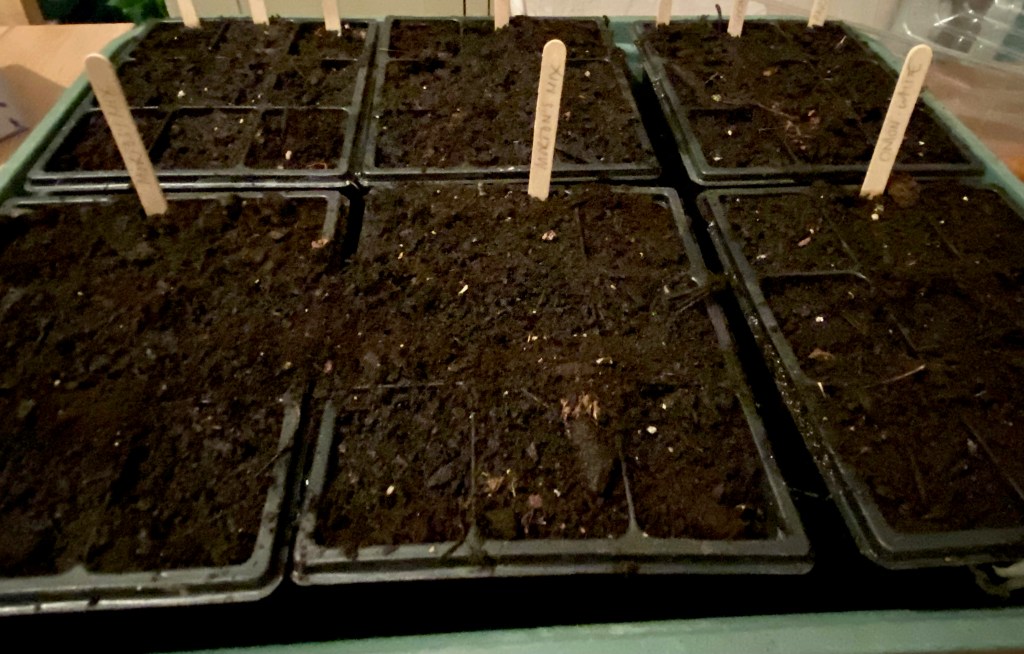
One of Charles Dowding’s really useful pieces of advice that I’ve not really followed in earnest before is to sow lots of your veggies, herbs and salads in modules, under cover, so that you have sturdy, healthy plants ready to plant out as soon as you have space on the plot. He also advocates successional, carefully timed sowing so that you have the right things growing and ready at the right times.
Growing in modules under cover in this way helps you make best use of the available space as you can plant straight after you harvest without having to wait for seedlings to germinate. It also gives the plants a better chance of fighting off slugs and other pests if they’re planted out already sturdy rather than growing them from seed in the ground which is when they’re at their most vulnerable. (They’ll need hardening off for a few days before planing out, of course.) This makes a lot of sense to me – last spring and summer I lost a lot of sowings, especially salad leaves, to slugs. So this year I’m going to sow more at home and see if that results in a higher than usual conversion rate of seeds to seedlings to harvestable plants.
My next challenge is to properly write down my sowing plan for the year so I can time my sowings right throughout the year and be able to plant new things out as soon as I harvest the spring and summer’s veggies. It seems like it’s really important to be quite planned and deliberate about it. I’m normally a bit more random than that, sowing things when it occurs to me or when spaces become available.
This works fine in the spring and early summer when most things grow away quickly and you can make up a couple of lost weeks fairly easily. But the lack of planning around late summer sowings in particular really shows in the form of a lack of viable plants to take into the autumn and winter. I’d really like to improve how I manage this this year, so I’ll be doing a more detailed plan of what to sow and when, and try to have a steady stream of small healthy plants ready to fill spaces as they appear, right through to September.
Planting out the first salad leaves of the year
I’ve planted out about 15 baby salad plants I sowed late last autumn into the front garden VegTrug bed – the first things to be grown in the bed. It’s exciting to get that new bed going – I’ve got high hopes for it this year. I’m hoping to be able to pick a whole salad from the bed once we get to June, July and August, and then to have winter salad leaves growing in it through the autumn and winter.
These particular plants are a mix from suttons – Spicy Mix and Winter Mix. They’re covered with a plastic tunnel cover which should keep the worst of the rain and wind off them. I’m hoping to be able to take my first harvests in April if they grow away strongly, and finish them up before planting out tender veg and a fresh load of salad leaves in May / June.
Before planting, I added some biochar to the manure and compost I’d already put in the bed, to help retain moisture and nutrients, and and topped the bed up with a bag of peat-free multipurpose compost that would be suitable to sow seeds into.
I try not to wish time away, but I must admit that this December and January I was really itching to get on with growing, and finding the short days with no time outside in daylight miserable. It feels great to be getting going with the growing year, and even better to be stealing a march on the season by growing things indoors a few weeks earlier than I was able to do before.

 Keeping the Plot
So happy to see another allotment gardener sowing seeds and looking forward to the growing year ahead. Your seedlings look lovely and healthy. Happy sowing!
LikeLiked by 1 person
That tall greenhouse is absolutely gorgeous! Hope all your planning and seeding work out just as you’ve scheduled it.
LikeLiked by 1 person
Thanks! I am smitten with the greenhouse! The sowing part is easy, it’s getting them from seedling to happy adult plant I find much more tricky, with slugs, cold, wet and drought to contend with…..
LikeLike